- Join our Team
- Resources
-
Account
- Cart
- EN FR

Exchanging 3D Models with PMI using STEP
July 21, 11
Article by Datakit in ProductData Journal, edition 2011-1, published by ProSTEP iViP Association
Christian Caillet
DATAKIT
Lyon, France
Summary
The new STEP protocol AP242 is aimed to improve interoperability and archiving of product data. From the experience of AP214 and projects on archiving, proposals have been made to extend STEP, in particular for PMI. This concerns new entity types, practical rules to use them, validation rules. DATAKIT is involved in the works on AP242 from the beginning, especially in the domain of PMI, in the frame of CAx-IF and LOTAR (studies, pilot projects for prototyping, interoperability tests). In order to provide STEP exchange tools ready on time when AP242 will become public.
Actual situation, coming steps
STEP is moving ahead to improve interoperability and archiving of product data. Result is a new STEP protocol, AP242 : "Managed Model Based 3D Engineering".
PMI (Product and Manufacturing Information) are supported in STEP : as a graphical presentation (man-readable, for display, visual inspection), and as a semantic representation (machine-readable, can then be exploited by software applications like metrology, machining ..). Ideally the both are used together. In practice the graphical presentation can be used as drawing is already used.
It is already possible to exchange PMI with STEP AP214 : under graphical form (presentation) as annotations, and under semantic form (representation), however the available semantic descriptions have shown limitations for some uses, especially archiving.
For PMI as for other domains, studies and proposals have been made to list the needed extensions for interoperability and long term archiving on product data : having a consistent and complete model for long term archiving has been a strong motivation for them.
Last upgrades of AP214 (to Edition 3) and of AP203 (to Edition 2) address some of these needs (for instance Composite Materials by using definitions from AP209). But several domains remain to be covered, or completed, on several protocols (AP203, AP214 ..), this means multiplied efforts on several protocols, with a concern for harmonization between them.
This situation has motivated the development of a new STEP protocol : AP242. AP242 gives the common frame for these completions. Because some definitions need longer studies and tests, several phases will take place.
The case of PMI
Needs for extensions concern the semantic description of PMI, to cover the existing standards (ISO 1101 , ASME Y14.5 ..), on various domains (dimensioning and tolerancing, also surface conditions, threads, weldings, ..). Also PMI in assembly, to locate the concerned geometries (links between geometries of different components, across the assembly). The domain of PMI has also links with Machining Features, which will also be part of AP242.
This defines a very large scope, and some definitions need additional studies (especially for PMI in assembly). So there will be several phases. The goal of the first phase (AP242 Edition 1) is to be complete enough to allow exchange of the mostly used types of PMI, attached to a 3D Part, and archiving of a 3D Part with consistent semantic PMI.
Added to definition of data types, tests and prototypes are needed to check how to read and write them, how they map in detail with native CAD data : about data types, also about constructs (links between PMI and geometries, particular types of dimensions, etc).
In addition, archiving data for long term needs a way to check if the archive is correct : validation properties are defined to be saved along with the data they are attached to (e.g. volume of solids, number of items, equivalent text for a PMI, etc). They are required to be representative of data integrity, and easy to check for a non-ambiguous result. Addressing a domain like PMI also means to define validation properties for it.
The first version of AP242 will bring a comprehensive set of definitions to read and write PMI attached on 3D Parts with their semantic description as well as their graphical presentation. Some definitions will come later, as well as PMI in assembly (especially the geometric links across an assembly), Machining Features.
Hence, when AP242 Version 1 will become public, its scope is to cover the most common standards on PMI, even if not complete. Starting on AP242 will improve exchange processes, this will help for further phases. Some remarks :
- writing PMI as only graphical allows to write any kind of PMI, only for viewing, visual inspection,
- writing PMI as semantic is machine readable, can then be used in downstream applications,
- for semantic definitions not yet supported, PMI are to be written as annotations (graphical only).
 |
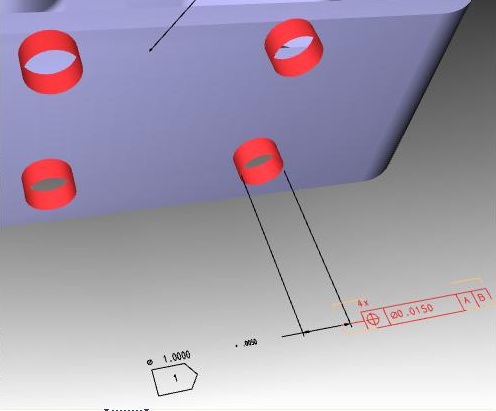 |
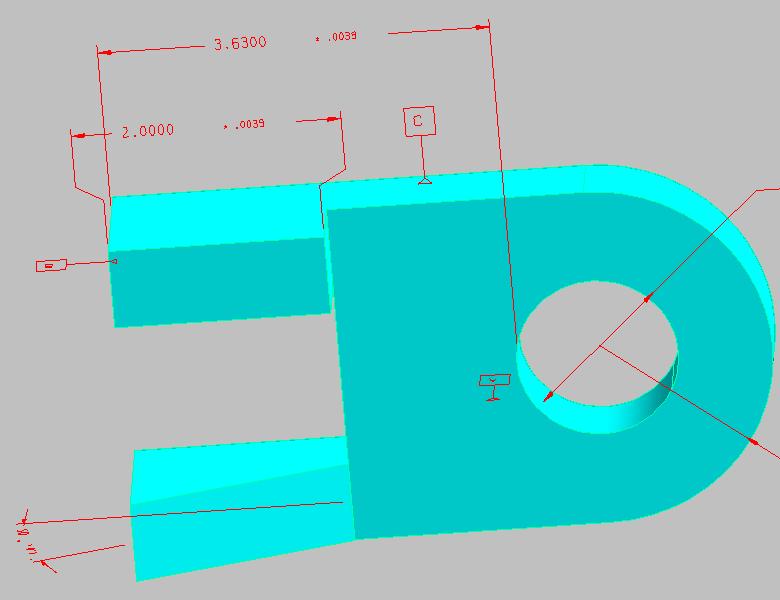
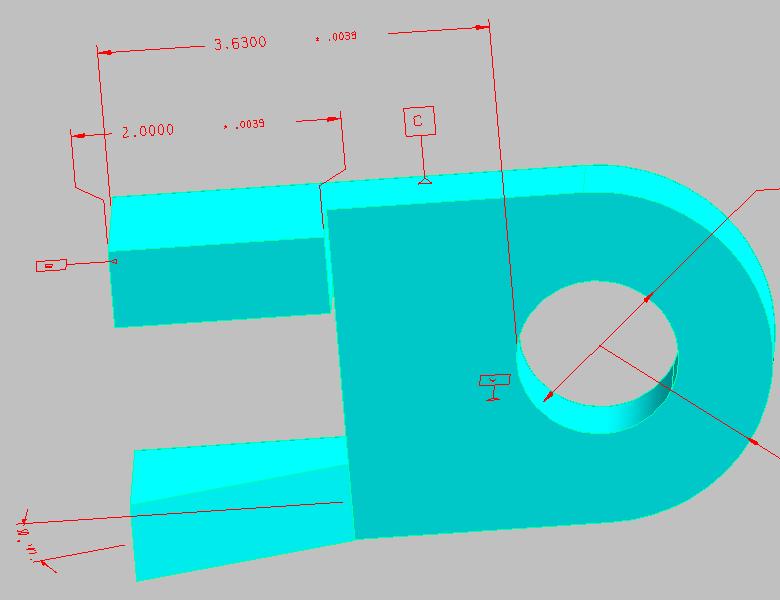
| Figure 1 : a Part with several dimensions, one is specified "to nearest side" of the cylinder. | Figure 2 : dimensions / tolerances applied to several features (one is graphically linked, with indication "4X", and all are logically linked) |
Works on extensions of STEP
Actual works on STEP about long term archiving of product data are made in the frame of LOTAR group. in relation with ISO (TC184) for the standardization work. They are organized in Work groups, for specific domains. One of them is dedicated to PMI.
Studies are made to enrich the protocol AP242 itself, definition of validation properties, recommended practices which help software editors to implement STEP.
New definitions should cover the standards for geometrical dimensioning and tolerancing (especially ASME Y14.5, ISO 1101), and ensure compatibility with existing definitions.
Pilot projects allow to prototype and test new entities and constructs, to check possible issues and limits, and propose solutions : how to write and read them, are there issues, problems of interpretation...
These works go in addition to interoperability tests, performed in the frame of CAx-IF forum within which software vendors check and improve their STEP exchange tools, for the best interoperability between them on CAD models.
DATAKIT is a long term actor in STEP. Its STEP reader and writer are part of CrossManager, which allow users to get data of various types from native CAD files, interprete them in a common way, for direct use or archival, read and write CAD data to or from standard files.
In regard of how strategic are interoperability and archiving in the industrial world, how vast is the scope of data types to address, and the issues and limitations which can be met, we think it is a strong help to directly contribute to the STEP AP242 project.
DATAKIT is involved for years in the works on STEP : interoperability tests in the CAx-IF forum, works in the LOTAR group. Our commitment in the works on new STEP AP242 standard has started from its announcement. We work in the domain of implementation, in complement to the standardization itself, to check what can really be made in STEP exchanges, the issues to solve. This leads us to :
- Participate in the works of LOTAR group to study, check, prototype, the proposals done for AP242.
- Get ready to update our STEP processors when STEP AP242 is made public. This also includes interoperability tests done in CAx-IF, to validate the solution.
- Continue on our native CAD readers to be in phase with the definitions of STEP AP242.
The purpose is to provide STEP exchange tools as complete as possible, ready on time when AP242 will become public.